Who Do You Choose to Be
Who Do You
Choose to Be
“If every rule requires interpretation, how do we know that we’re following it correctly?”
— Ludwig Wittgenstein
“If every rule requires interpretation, how do we know that we’re following it correctly?”
— Ludwig Wittgenstein
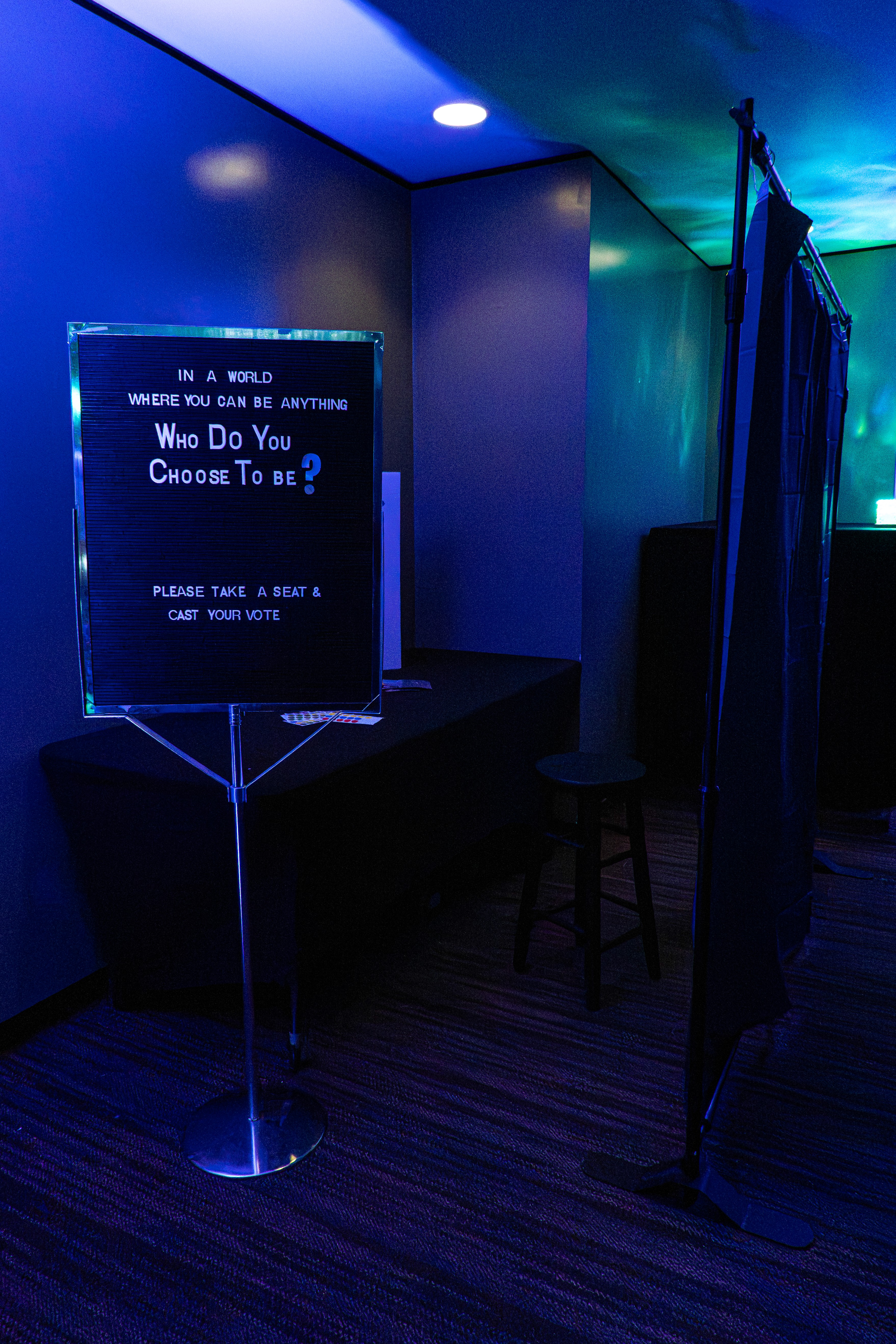
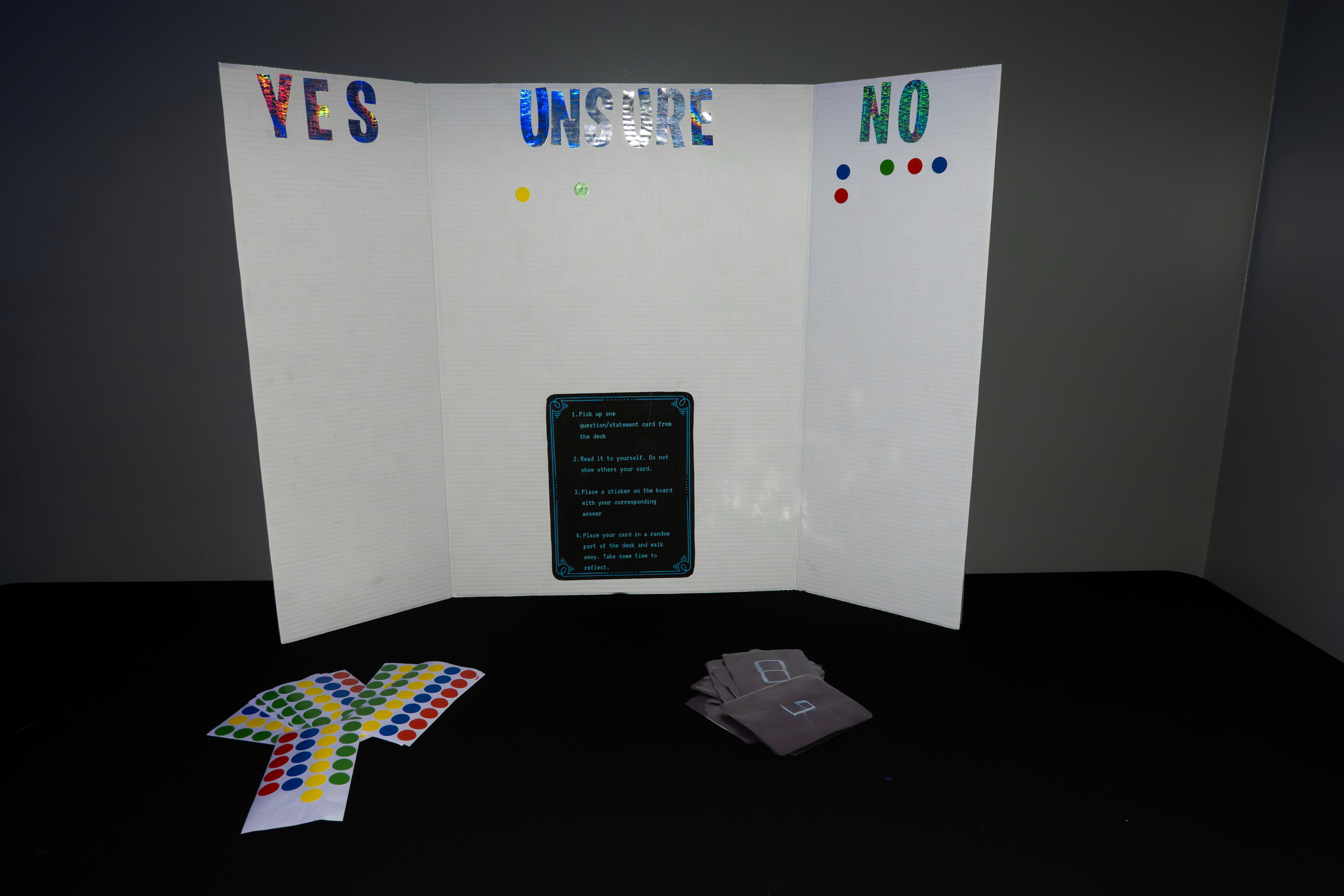
This installation invites audiences to confront the instability of moral certainty before entering The Nether. Functioning as a threshold experience, it unsettles the assumption that ethical decisions are clear or easily resolved. Upon entering, audience members encounter a set of cards, each containing an ambiguous ethical statement or question. Participants select one card and respond by placing a vote: yes, no, or unsure. In doing so, they are prompted to reflect on their instinctive moral judgments.
The aim of this installation is to prepare spectators for the ethical complexity at the heart of The Nether. The play interrogates responsibility, legality, and morality within a rule-governed digital environment that remains ethically troubling. This installation mirrors that tension. While the activity follows a simple structure—choose a card, cast a vote—the statements themselves resist clear answers. The audience’s transition is therefore psychological: spectators move from a position of assumed moral clarity into one of doubt, reflection, and self-questioning. In this way, the work operates as a threshold that fosters ethical attentiveness.
Conceptually, the installation explores the relationship between rule-following and moral ambiguity. While ethical systems often rely on rules to guide behavior, The Nether exposes their limitations in complex situations. The installation asks: Is following the rules enough to make an action ethical? Drawing on Victor Turner’s distinction, the work functions as a liminoid experience—a voluntary, reflective encounter rather than a fixed ritual. Although participation is optional, the collective act of voting generates a shared awareness of disagreement and uncertainty.
This approach prepares audiences to engage more deeply with the play’s themes. Michael Chekhov describes the pre-performance moment as a psychological threshold, where spectators shift from everyday perception to imaginative openness. By prompting audiences to question their own moral assumptions, the installation initiates this transition. The act of choosing and voting encourages spectators to enter the theatre already engaged in ethical reflection, ready to grapple with the dilemmas presented in the play.
At the same time, the installation positions audiences as active contributors to meaning. Helen Freshwater argues that audiences co-create interpretation rather than passively receive it. The visible accumulation of votes reveals differences in perspective, reinforcing the idea that ethical meaning is collectively negotiated.
Ultimately, the installation prepares audiences to enter The Nether with a heightened awareness of the complexity of moral judgment. By confronting participants with ambiguity and inviting collective reflection, the work establishes the ethical and imaginative conditions for a deeper engagement with the play.
This installation invites audiences to confront the instability of moral certainty before entering The Nether. Functioning as a threshold experience, it unsettles the assumption that ethical decisions are clear or easily resolved. Upon entering, audience members encounter a set of cards, each containing an ambiguous ethical statement or question. Participants select one card and respond by placing a vote: yes, no, or unsure. In doing so, they are prompted to reflect on their instinctive moral judgments.
The aim of this installation is to prepare spectators for the ethical complexity at the heart of The Nether. The play interrogates responsibility, legality, and morality within a rule-governed digital environment that remains ethically troubling. This installation mirrors that tension. While the activity follows a simple structure—choose a card, cast a vote—the statements themselves resist clear answers. The audience’s transition is therefore psychological: spectators move from a position of assumed moral clarity into one of doubt, reflection, and self-questioning. In this way, the work operates as a threshold that fosters ethical attentiveness.
Conceptually, the installation explores the relationship between rule-following and moral ambiguity. While ethical systems often rely on rules to guide behavior, The Nether exposes their limitations in complex situations. The installation asks: Is following the rules enough to make an action ethical? Drawing on Victor Turner’s distinction, the work functions as a liminoid experience—a voluntary, reflective encounter rather than a fixed ritual. Although participation is optional, the collective act of voting generates a shared awareness of disagreement and uncertainty.
This approach prepares audiences to engage more deeply with the play’s themes. Michael Chekhov describes the pre-performance moment as a psychological threshold, where spectators shift from everyday perception to imaginative openness. By prompting audiences to question their own moral assumptions, the installation initiates this transition. The act of choosing and voting encourages spectators to enter the theatre already engaged in ethical reflection, ready to grapple with the dilemmas presented in the play.
At the same time, the installation positions audiences as active contributors to meaning. Helen Freshwater argues that audiences co-create interpretation rather than passively receive it. The visible accumulation of votes reveals differences in perspective, reinforcing the idea that ethical meaning is collectively negotiated.
Ultimately, the installation prepares audiences to enter The Nether with a heightened awareness of the complexity of moral judgment. By confronting participants with ambiguity and inviting collective reflection, the work establishes the ethical and imaginative conditions for a deeper engagement with the play.
Lex Podrats, Dramaturg
Lex Podrats, Dramaturg
Installation GALLERY
We acknowledge that this theatre and the university that holds it stand on the traditional territories of the Attawandaron (also known as the Neutral), Anishinaabeg, and Haudenosaunee peoples. Our main campus is in Block 2 of the Haldimand Tract, land promised in 1784 by the British Crown to the Haudenosaunee of the Grand River in recognition of their alliance during the American Revolution.
This territory, which includes six miles on either side of the Grand River, is governed by the Dish with One Spoon Wampum, an agreement that teaches that the land is a shared dish from which we all eat, and that we carry collective responsibilities: to take only what we need, to ensure there is enough for others, and to keep the dish clean for those who come after us. It is an agreement rooted in care, reciprocity, and stewardship.
Gathering here in this theatre, on this land, within this agreement, means recognizing that welcome comes with responsibility. It asks us to consider how we move through shared spaces, how we care for one another, and how the systems we build shape access, safety, and belonging as equal partners.
We acknowledge that this theatre and the university that holds it stand on the traditional territories of the Attawandaron (also known as the Neutral), Anishinaabeg, and Haudenosaunee peoples. Our main campus is in Block 2 of the Haldimand Tract, land promised in 1784 by the British Crown to the Haudenosaunee of the Grand River in recognition of their alliance during the American Revolution.
This territory, which includes six miles on either side of the Grand River, is governed by the Dish with One Spoon Wampum, an agreement that teaches that the land is a shared dish from which we all eat, and that we carry collective responsibilities: to take only what we need, to ensure there is enough for others, and to keep the dish clean for those who come after us. It is an agreement rooted in care, reciprocity, and stewardship.
Gathering here in this theatre, on this land, within this agreement, means recognizing that welcome comes with responsibility. It asks us to consider how we move through shared spaces, how we care for one another, and how the systems we build shape access, safety, and belonging as equal partners.