The missing Piece
The missing Piece
Before and after a performance, actors often participate in an exercise known as
“crossing the threshold.” Coined by actor, director, and theatre instructor Michael
Chekhov, this practice supports actors in transitioning from everyday life into the
imaginative world of the play by setting aside external concerns and becoming fully
present. Through years of research, Chekhov developed a series of psychological
exercises to facilitate this shift. This installation adapts those exercises, offering
audience members the opportunity to engage in a similar process of preparation and
presence. Audience members are invited into a state of imaginative readiness by
pausing and engaging with the installation. Drawing from Chekhov’s work, the space
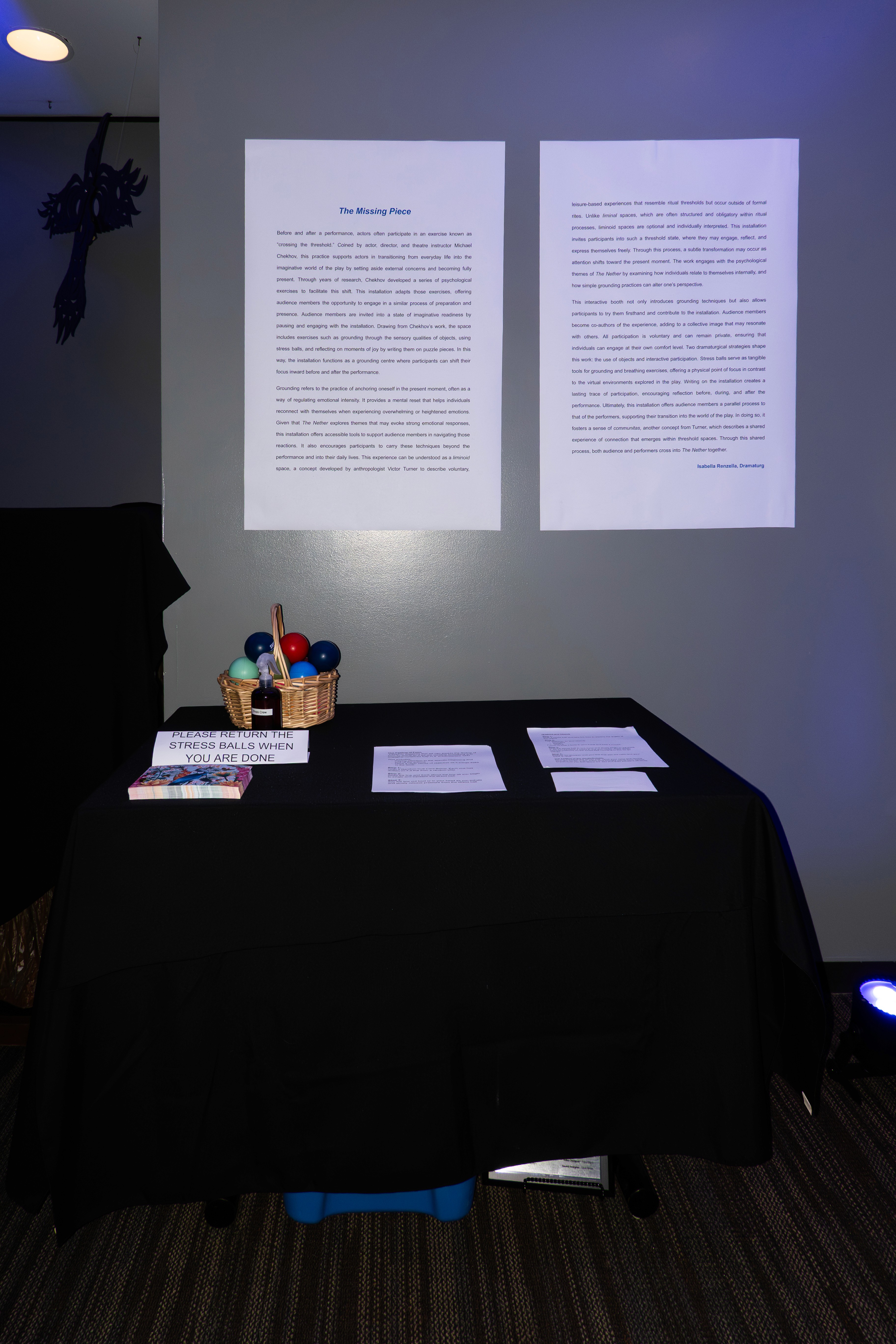
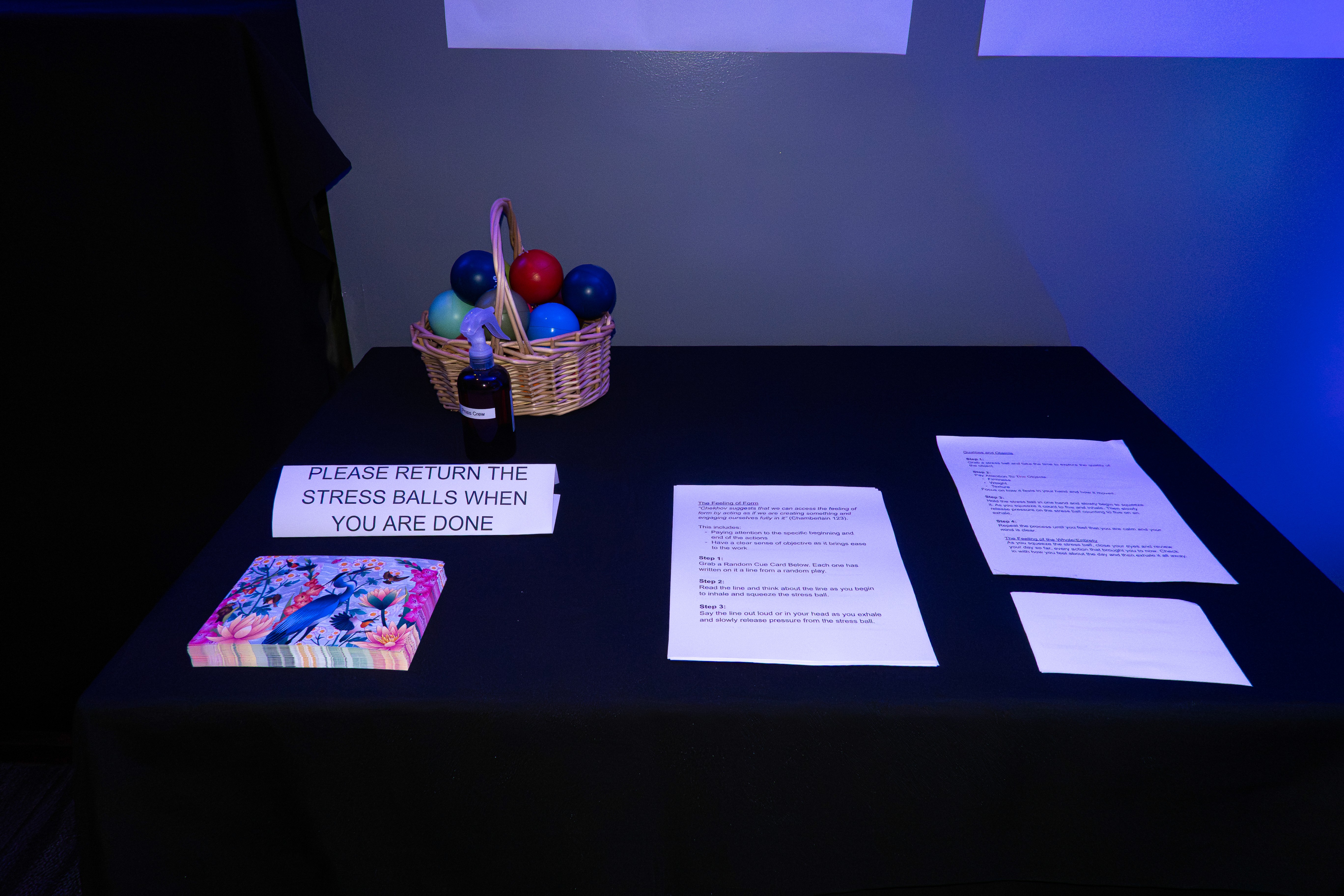
includes exercises such as grounding through the sensory qualities of objects, using
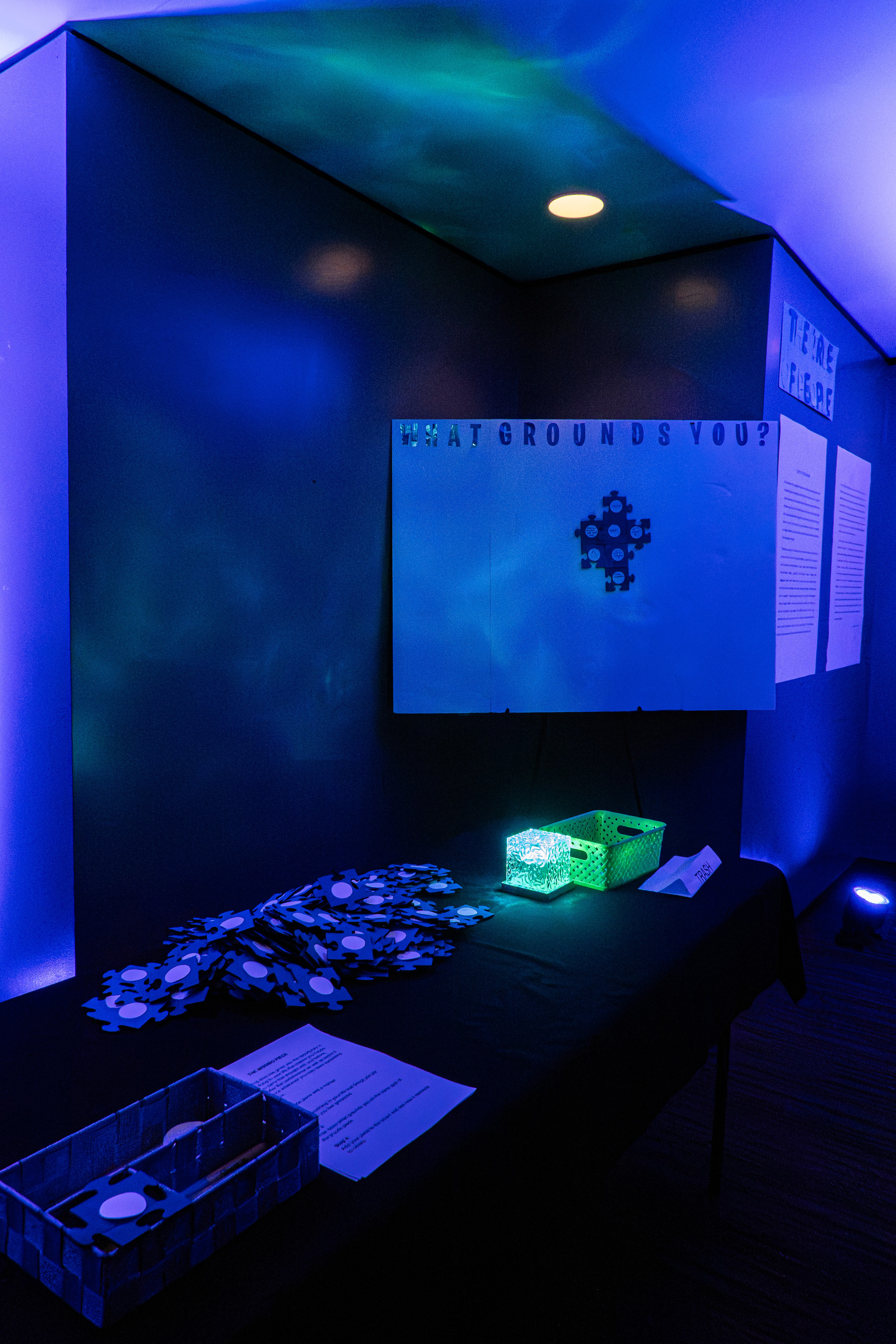
stress balls, and reflecting on moments of joy by writing them on puzzle pieces. In this
way, the installation functions as a grounding centre where participants can shift their
focus inward before and after the performance.
Grounding refers to the practice of anchoring oneself in the present moment, often as a
way of regulating emotional intensity. It provides a mental reset that helps individuals
reconnect with themselves when experiencing overwhelming or heightened emotions.
Given that The Nether explores themes that may evoke strong emotional responses,
this installation offers accessible tools to support audience members in navigating those
reactions. It also encourages participants to carry these techniques beyond the
performance and into their daily lives. This experience can be understood as a liminoid
space, a concept developed by anthropologist Victor Turner to describe voluntary,
leisure-based experiences that resemble ritual thresholds but occur outside of formal
rites. Unlike liminal spaces, which are often structured and obligatory within ritual
processes, liminoid spaces are optional and individually interpreted. This installation
invites participants into such a threshold state, where they may engage, reflect, and
express themselves freely. Through this process, a subtle transformation may occur as
attention shifts toward the present moment. The work engages with the psychological
themes of The Nether by examining how individuals relate to themselves internally, and
how simple grounding practices can alter one’s perspective.
This interactive booth not only introduces grounding techniques but also allows
participants to try them firsthand and contribute to the installation. Audience members
become co-authors of the experience, adding to a collective image that may resonate
with others. All participation is voluntary and can remain private, ensuring that
individuals can engage at their own comfort level. Two dramaturgical strategies shape
this work: the use of objects and interactive participation. Stress balls serve as tangible
tools for grounding and breathing exercises, offering a physical point of focus in contrast
to the virtual environments explored in the play. Writing on the installation creates a
lasting trace of participation, encouraging reflection before, during, and after the
performance. Ultimately, this installation offers audience members a parallel process to
that of the performers, supporting their transition into the world of the play. In doing so, it
fosters a sense of communitas, another concept from Turner, which describes a shared
experience of connection that emerges within threshold spaces. Through this shared
process, both audience and performers cross into The Nether together.
Before and after a performance, actors often participate in an exercise known as
“crossing the threshold.” Coined by actor, director, and theatre instructor Michael
Chekhov, this practice supports actors in transitioning from everyday life into the
imaginative world of the play by setting aside external concerns and becoming fully
present. Through years of research, Chekhov developed a series of psychological
exercises to facilitate this shift. This installation adapts those exercises, offering
audience members the opportunity to engage in a similar process of preparation and
presence. Audience members are invited into a state of imaginative readiness by
pausing and engaging with the installation. Drawing from Chekhov’s work, the space
includes exercises such as grounding through the sensory qualities of objects, using
stress balls, and reflecting on moments of joy by writing them on puzzle pieces. In this
way, the installation functions as a grounding centre where participants can shift their
focus inward before and after the performance.
Grounding refers to the practice of anchoring oneself in the present moment, often as a
way of regulating emotional intensity. It provides a mental reset that helps individuals
reconnect with themselves when experiencing overwhelming or heightened emotions.
Given that The Nether explores themes that may evoke strong emotional responses,
this installation offers accessible tools to support audience members in navigating those
reactions. It also encourages participants to carry these techniques beyond the
performance and into their daily lives. This experience can be understood as a liminoid
space, a concept developed by anthropologist Victor Turner to describe voluntary,
leisure-based experiences that resemble ritual thresholds but occur outside of formal
rites. Unlike liminal spaces, which are often structured and obligatory within ritual
processes, liminoid spaces are optional and individually interpreted. This installation
invites participants into such a threshold state, where they may engage, reflect, and
express themselves freely. Through this process, a subtle transformation may occur as
attention shifts toward the present moment. The work engages with the psychological
themes of The Nether by examining how individuals relate to themselves internally, and
how simple grounding practices can alter one’s perspective.
This interactive booth not only introduces grounding techniques but also allows
participants to try them firsthand and contribute to the installation. Audience members
become co-authors of the experience, adding to a collective image that may resonate
with others. All participation is voluntary and can remain private, ensuring that
individuals can engage at their own comfort level. Two dramaturgical strategies shape
this work: the use of objects and interactive participation. Stress balls serve as tangible
tools for grounding and breathing exercises, offering a physical point of focus in contrast
to the virtual environments explored in the play. Writing on the installation creates a
lasting trace of participation, encouraging reflection before, during, and after the
performance. Ultimately, this installation offers audience members a parallel process to
that of the performers, supporting their transition into the world of the play. In doing so, it
fosters a sense of communitas, another concept from Turner, which describes a shared
experience of connection that emerges within threshold spaces. Through this shared
process, both audience and performers cross into The Nether together.
Isabella Renzella, Dramaturg
Isabella Renzella, Dramaturg
Installation GALLERY
We acknowledge that this theatre and the university that holds it stand on the traditional territories of the Attawandaron (also known as the Neutral), Anishinaabeg, and Haudenosaunee peoples. Our main campus is in Block 2 of the Haldimand Tract, land promised in 1784 by the British Crown to the Haudenosaunee of the Grand River in recognition of their alliance during the American Revolution.
This territory, which includes six miles on either side of the Grand River, is governed by the Dish with One Spoon Wampum, an agreement that teaches that the land is a shared dish from which we all eat, and that we carry collective responsibilities: to take only what we need, to ensure there is enough for others, and to keep the dish clean for those who come after us. It is an agreement rooted in care, reciprocity, and stewardship.
Gathering here in this theatre, on this land, within this agreement, means recognizing that welcome comes with responsibility. It asks us to consider how we move through shared spaces, how we care for one another, and how the systems we build shape access, safety, and belonging as equal partners.
We acknowledge that this theatre and the university that holds it stand on the traditional territories of the Attawandaron (also known as the Neutral), Anishinaabeg, and Haudenosaunee peoples. Our main campus is in Block 2 of the Haldimand Tract, land promised in 1784 by the British Crown to the Haudenosaunee of the Grand River in recognition of their alliance during the American Revolution.
This territory, which includes six miles on either side of the Grand River, is governed by the Dish with One Spoon Wampum, an agreement that teaches that the land is a shared dish from which we all eat, and that we carry collective responsibilities: to take only what we need, to ensure there is enough for others, and to keep the dish clean for those who come after us. It is an agreement rooted in care, reciprocity, and stewardship.
Gathering here in this theatre, on this land, within this agreement, means recognizing that welcome comes with responsibility. It asks us to consider how we move through shared spaces, how we care for one another, and how the systems we build shape access, safety, and belonging as equal partners.