MEET THE VIRTUAL SCENOGRAPHER
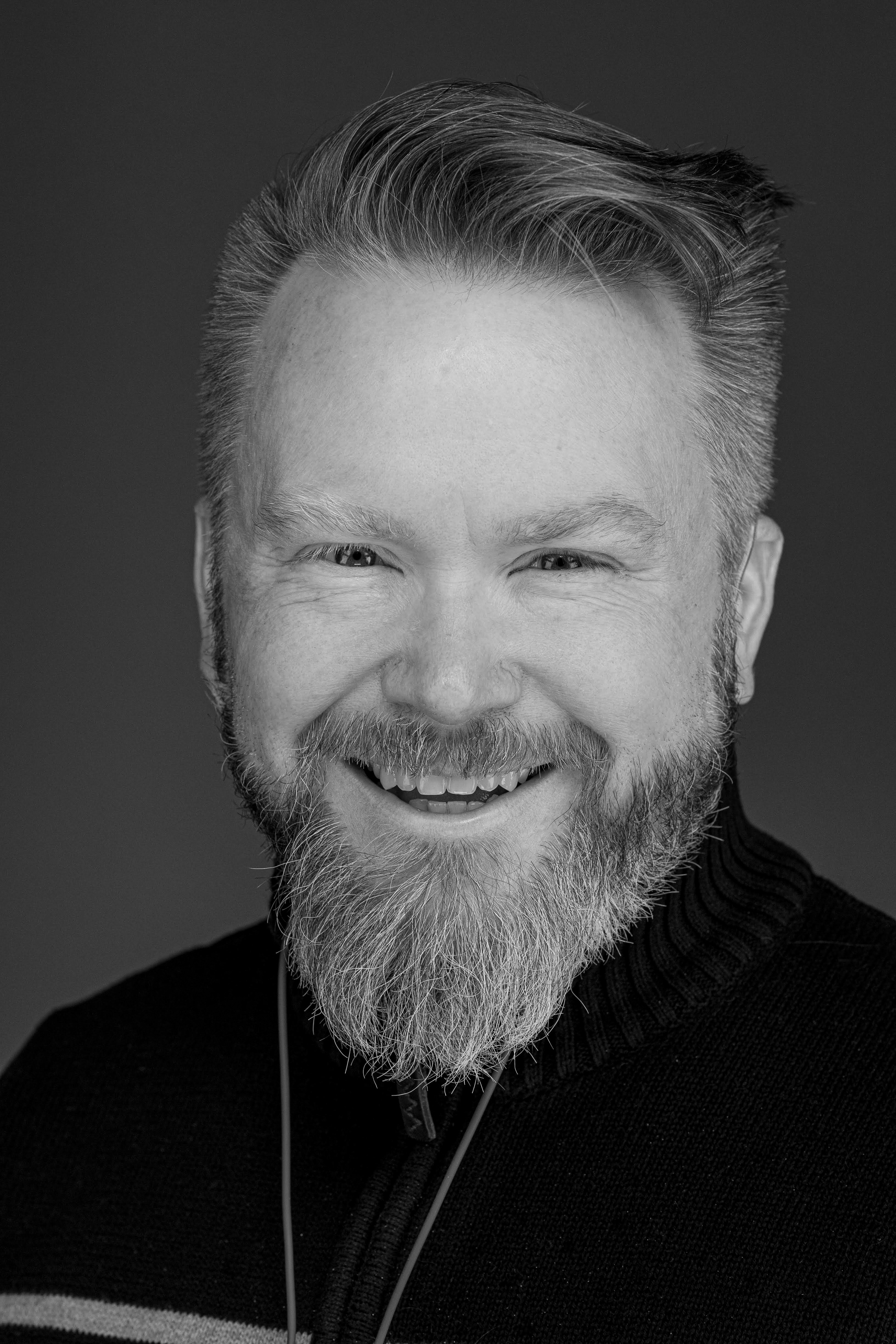
Dr Owen Brierley is a distinguished figure in digital arts and technology, renowned for merging innovative teaching with pioneering research. Holding a PhD from the University of Calgary, his work delves into game engines as platforms for scholarly inquiry, examining the intersection of technology and human enhancement. Brierley's educational philosophy emphasises risk-taking and dignity in inclusive settings, fostering environments where students can explore, grow, and express creatively. His transformative approach integrates technological applications with artistic principles, having held roles such as executive director and curriculum designer across various educational institutions.
Brierley's transdisciplinary research spans machine learning, bioinformatics visualisation, and human-computer interaction, focusing on enhancing human experiences through interactive media. His contributions are internationally recognised, with numerous publications and presentations in cities like Edmonton, Vancouver, and Washington D.C. Beyond academia, he's held leadership positions in organisations like Digital Alberta and the Canadian Communications Foundation, driving digital innovation.
During his tenure as executive director of the Edmonton Digital Arts College from 2008 to 2019, Brierley expanded the college by over 1,400%, introducing three new diploma programs and emphasizing a research-led curriculum tailored to individual learner needs. His efforts ensured a personalised learning experience, maintaining small class sizes for effective instruction.
Brierley is also an active artist and designer, collaborating in theatre, dance, music, and visual arts. His work has been featured in prestigious venues like the Banff Centre for the Arts and the Citadel Theatre. Dr Owen Brierley stands out for his commitment to enriching the human spirit through the lens of digital media, blending educational innovation with artistic exploration.
Can you tell me a bit about yourself and how you got involved in this production?
I'm Owen Brierley, a Course Leader and Senior Lecturer at Kingston School of Art in London, with a background spanning interactive digital media, theatre, live events, and game design. My involvement in *The Nether* started almost exactly a year ago over pints at a pub in Kingston Upon Thames in the UK. My friend and collaborator Zach told me he'd been given the green light to produce and direct the show at the University of Waterloo, and knowing I was friends with playwright Jennifer Haley and had a research interest in digital empathy, asked if I'd want to be part of it. I said yes immediately. I took on the virtual world design and build and started calling myself the Virtual Scenographer (fake it til you make it?), working from five time zones away while juggling my full-time role at Kingston School of Art at Kingston University London.
What were you most excited about seeing come to life through thiS process?
There was a moment during a performance when one of the actors, playing Iris, was holding a small plush bunny rabbit. In a completely natural, almost absent-minded way, she began gently stroking it, as if it were a beloved pet. It was fleeting. Easy to miss. But it stopped me cold. Here was an actor fully inhabiting their avatar in a virtual world, generating that same magic you see in great mask work or puppetry, where the audience is quietly invited to suspend disbelief and follow the emotional truth of the performance. That moment convinced me that genuine theatrical presence is possible in VR. It was the kind of moment that animators discover, like the moment in "Up" where Carl absent0mindedly rubs his nose while tying off the balloons to a tree (a moment that the animator had capture in their own performance of the scene while creating the animation). This was the kind of moment that Zach and I had yearned for from our earliest conversations about creating theatre in virtual spaces. These moments make us forget about the artifice of theatre (real or virtual) and allow us into the emotional life of the performance.
What is the biggest challenge you encountered during this process?
The platform pivot. We had originally been building in Unreal Engine, which is cinematic and lush, and then discovered that the audience would need to access the show via standalone VR headsets. That meant switching entirely to Unity and VRChat, with a world file size limit of just 100 MB. I had to rebuild everything within those constraints, often running 100+ build iterations per world in a cycle of test, tweak, compile, and test again.
The breakthrough came during Tech Week in a conversation with ASM Renee Walker, who asked whether there was an easy way for the actors to move between the inside and outside of the Hideaway. That question made me stop and wonder if combining the separate worlds was actually possible. I tried it, and it worked. Converting a problematic 3D file format was the final piece, and suddenly all the worlds could live as one. The audience never had to be split up, and our floor director could move everyone through the show seamlessly.
Another unexpected gift came from my colleague at Kingston School of Art, Tommaso Di Filippo, who introduced me to a way of connecting Claude AI directly to my Unity project. That allowed me to iterate through the remaining production needs far faster than I could have managed alone. It was one of those moments where the right tool arrives at exactly the right time. The whole experience felt like a true theatre production, made possible by the people around me. I am eternally grateful to Zach, over pints at the Albion, inviting me to join him on this increible adventure.