Why This Show

Meet The People

Connect

Why This Show

Meet The People

Connect

Why This Show

Meet The People

Connect

How Long Until Doomsday?

We turn to the media to escape our lives, to take a break from the demands of capitalism and society, and to connect with a virtual space where we have complete control over our narrative, audience, and identity. Each of our worlds is tailored to our interests, our passions, and our fears. The emotions our worlds evoke in us are what keep us wanting more and drawing us more into the screens and algorithms that are. By escaping to these infinite worlds, we are neglecting the planet we share and causing irreparable damage to our water, air, wildlife, and environment, collectively known as the climate crisis. Climate change became a concern in the 1950s during industrialization, but has consistently been deprioritized in favour of money and power.

We turn to the media to escape our lives, to take a break from the demands of capitalism and society, and to connect with a virtual space where we have complete control over our narrative, audience, and identity. Each of our worlds is tailored to our interests, our passions, and our fears. The emotions our worlds evoke in us are what keep us wanting more and drawing us more into the screens and algorithms that are. By escaping to these infinite worlds, we are neglecting the planet we share and causing irreparable damage to our water, air, wildlife, and environment, collectively known as the climate crisis. Climate change became a concern in the 1950s during industrialization, but has consistently been deprioritized in favour of money and power.

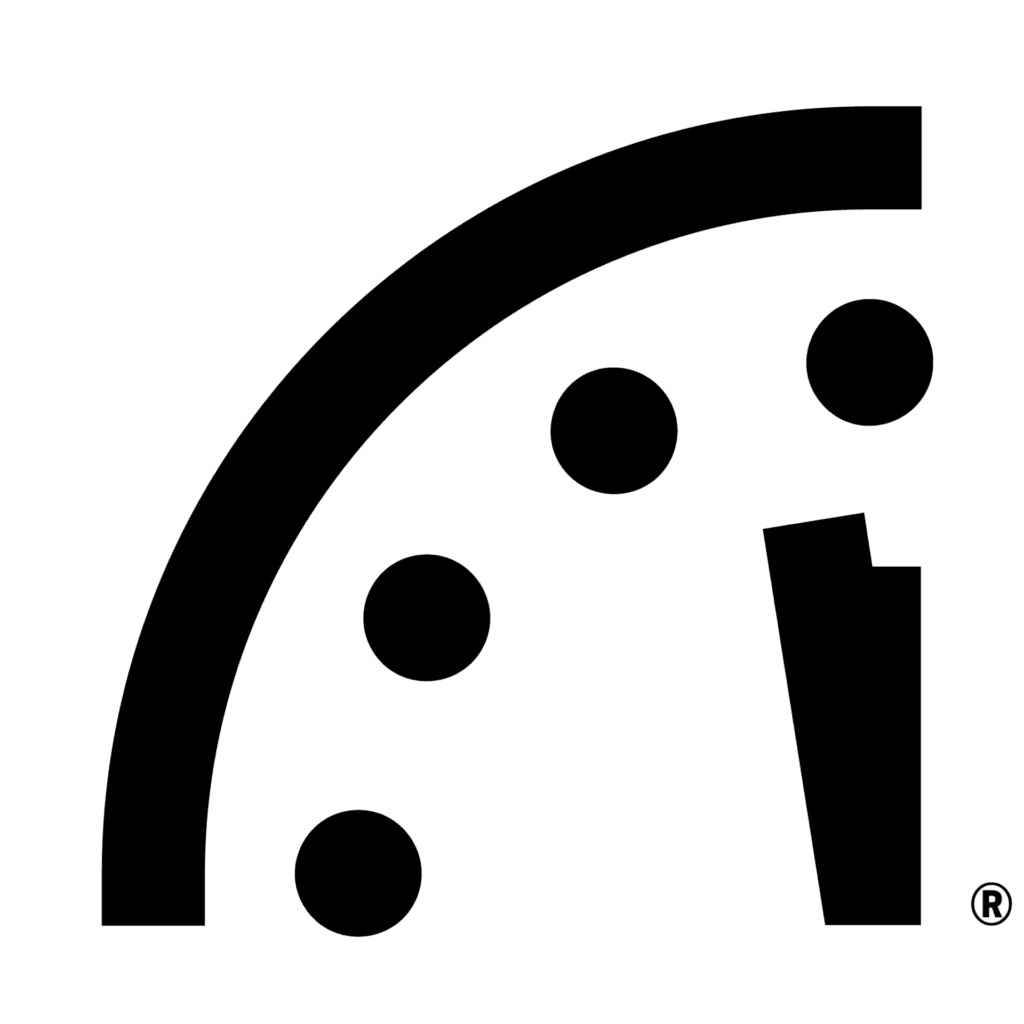
What is the doomsday clock?

​The doomsday clock was created to warn the public about how close society is to permanent or irreparable damage to our world due to human technological, social, and geopolitical problems. The time is determined by the Science and Security board, which interprets international issues to determine how much time remains until midnight.

​The doomsday clock was created to warn the public about how close society is to permanent or irreparable damage to our world due to human technological, social, and geopolitical problems. The time is determined by the Science and Security board, which interprets international issues to determine how much time remains until midnight.

How long until doomsday?

1945
1945

First Data Centre

The first data centre, called the mainframe, was built to support ENIAC at the University of Pennsylvania.

Doomsday Clock Created

The doomsday clock was created by Hyman Goldsmith and Martyl Langsdorf.

West Point, the Pentagon, and the CIA headquarters in the 1950s, and they had huge vents and fans to cool machines, since it was being used for defence and intelligence, secrecy and security.

1947
1947
1959
1959

Machine Learning

Arthur Samuel introduced the term machine learning in the context of making a robot play chess better.

Chatbot Therapist

Joseph Weizenbaum created the first chatbot therapist.

1966
1966
1991
1991

17 Minutes to Midnight

The doomsday clock was at 17 minutes to midnight, its furthest from midnight.

Amazon Rainforest

Study found that the Amazon rainforest is a carbon sink, but it becomes a carbon emitter.

2010
2010
2012
2012

More Data Centres

500,000 million data centres.

Life on Earth

68% of the world's mammals, fish, birds, reptiles, and amphibians since 1970.

2020
2020
2021
2021

Environmental Decline

We are in the sixth mass extinction, with 500 species at risk of extinction in 20 years.

2.5 billion tons of emissions were produced due to the loss of 3.75 million hectares of tropical trees.

The Present-Day Turning Point

10 million hectares of trees are cut down every year, which accounts fro 16% of tree cover and 96% if it's in tropical forests (most ecologically rich).

800 million data centres.

2.9 watt-hours of electricity are needed to process an AI prompt.

2026
2026
2027
2027

Environmental Impacts of AI

AI is expected to consume between 4 and 6 billion cubic meters of water to cool data centres.

Environmental Impact of Plastics

29 million tons per year of plastic and microplastics will enter the oceans, and 600 million tons in total waterways.

2040
2040
2050
2050

Extreme Heat

Nowhere will be unaffected by extreme heat.

Poor Air Quality

Deaths related to poor air quality will cost 18-25 trillion dollars.

2060
2060
2100
2100

Extinction of Emperor Penguins

Sea ice melt makes emperor penguins extinct.

I Miss The Trees

“I miss the trees” - Doyle, The Nether by Jennifer Haley

20XX
20XX

To avoid living in a world like the Nether, we need to make changes today.  Each change will help us delay doomsday.

How can we protect the environment?

  1. Stop Relying on AI. We have survived for thousands of years without it, and we are robbing ourselves of education and growth.

  2. Stop buying new tech if your existing tech is still in working condition and meets your needs. Don't buy new tech. If you need new tech, consider an open-box, refurbished, or older model that meets your needs. It helps save money and sends a signal to corporations that they don't need to produce mass amounts, reducing the need to extract resources to make tech.

  3. Reach out to your provincial and federal MPs to ask them to adopt the precautionary principle and act proactively rather than reactively on climate change.

  4. Recycle E-Waste by disposing of batteries and devices to give them a second life, ensuring they are safely managed to protect the environment from harmful chemicals and reduce demand for mining precious metals and minerals.

    • Fun fact: only 22% of e-waste is disposed of safely

  5. Optimize storage: unwanted or irrelevant data takes up space in the cloud (data centers), which requires immense resources to manage.

  6. Try to purchase Energy Star-certified devices.

  7. Plant more trees/ remove invasive plant species in your neighbourhood and make it a community initiative to foster real-world connections!

CITATIONS
We acknowledge that this theatre and the university that holds it stand on the traditional territories of the Attawandaron (also known as the Neutral), Anishinaabeg, and Haudenosaunee peoples. Our main campus is in Block 2 of the Haldimand Tract, land promised in 1784 by the British Crown to the Haudenosaunee of the Grand River in recognition of their alliance during the American Revolution.


This territory, which includes six miles on either side of the Grand River, is governed by the Dish with One Spoon Wampum, an agreement that teaches that the land is a shared dish from which we all eat, and that we carry collective responsibilities: to take only what we need, to ensure there is enough for others, and to keep the dish clean for those who come after us. It is an agreement rooted in care, reciprocity, and stewardship.


Gathering here in this theatre, on this land, within this agreement, means recognizing that welcome comes with responsibility. It asks us to consider how we move through shared spaces, how we care for one another, and how the systems we build shape access, safety, and belonging as equal partners.

We acknowledge that this theatre and the university that holds it stand on the traditional territories of the Attawandaron (also known as the Neutral), Anishinaabeg, and Haudenosaunee peoples. Our main campus is in Block 2 of the Haldimand Tract, land promised in 1784 by the British Crown to the Haudenosaunee of the Grand River in recognition of their alliance during the American Revolution.


This territory, which includes six miles on either side of the Grand River, is governed by the Dish with One Spoon Wampum, an agreement that teaches that the land is a shared dish from which we all eat, and that we carry collective responsibilities: to take only what we need, to ensure there is enough for others, and to keep the dish clean for those who come after us. It is an agreement rooted in care, reciprocity, and stewardship.


Gathering here in this theatre, on this land, within this agreement, means recognizing that welcome comes with responsibility. It asks us to consider how we move through shared spaces, how we care for one another, and how the systems we build shape access, safety, and belonging as equal partners.